
Neofelis diardi
The Sunda Clouded Leopard (Neofelis diardi) is a rare, medium-sized wild cat native to Borneo and Sumatra, renowned for its cloud-shaped markings and remarkable arboreal abilities.
The Sunda Clouded Leopard (Neofelis diardi) is a rare, medium-sized wild cat native to Borneo and Sumatra, renowned for its cloud-shaped markings and remarkable arboreal abilities.
Formally recognized as a distinct species in 2007, the Sunda Clouded Leopard was separated from its mainland relative (Neofelis nebulosa) after genetic and morphological studies led by Wilting et al. Its evolutionary roots trace back to Borneo and Sumatra, where it diverged from its sister species approximately 1.4 million years ago. The species' type locality is Borneo, and its discovery marked a significant milestone in felid taxonomy, highlighting the unique biodiversity of Southeast Asia's rainforests.
Belonging to the family Felidae and subfamily Pantherinae, the Sunda Clouded Leopard is classified under the genus Neofelis as the species diardi. It is one of two recognized species within its genus, forming a basal branch distinct from the larger Panthera cats such as tigers and lions. Previously considered a subspecies of the mainland Clouded Leopard, it is now fully acknowledged as a separate species due to its genetic and morphological differences.
The Sunda Clouded Leopard is instantly recognizable by its luxurious grayish or yellowish coat adorned with large, irregular, cloud-shaped dark markings edged in black. Its body is short and stocky, with powerful limbs and a long, bushy tail that nearly matches its body length, providing exceptional balance for life in the trees. The skull is robust, and its upper canines are strikingly long, reminiscent of ancient saber-toothed cats. Adults typically weigh between 12 and 25 kilograms, and their camouflage allows them to blend seamlessly into the dense rainforest shadows.
Highly elusive and solitary, Sunda Clouded Leopards are primarily nocturnal and crepuscular, spending much of their lives in the forest canopy. Their flexible ankle joints and powerful limbs enable them to climb, hang, and descend trees headfirst, making them one of the most arboreal of all wild cats. They hunt a variety of prey, including primates, small deer, birds, and occasionally domestic animals, playing a vital role as apex predators in their ecosystems. Direct human interaction is rare, but their presence is essential for maintaining healthy rainforest biodiversity.
Bring this kind into your world � illustrated posters, mugs, and shirts.

Archival print, museum-grade paper
Buy Poster
Stoneware mug, dishwasher safe
Buy Mug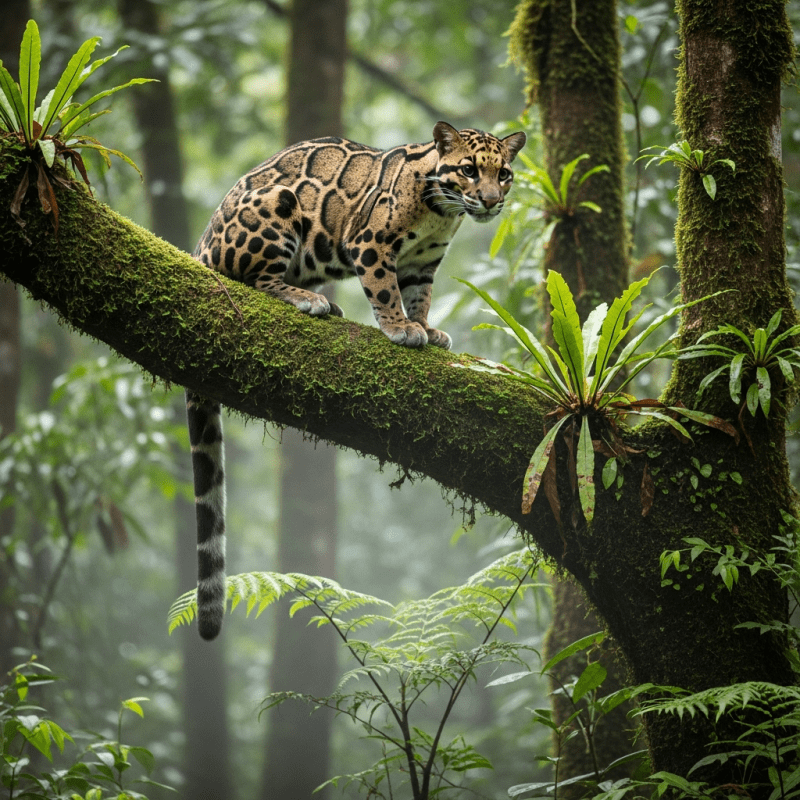
Soft cotton tee, unisex sizes
Buy ShirtWhile not as prominent in global folklore as some big cats, the Sunda Clouded Leopard holds a special place in local cultures. Known as "Harimau Dahan" in Malay and Indonesian, it is sometimes featured in regional stories and traditional beliefs, symbolizing the mystery and richness of the rainforest. Its elusive nature and striking appearance have made it a subject of fascination for wildlife enthusiasts and conservationists, though it remains less represented in art and media compared to its mainland relatives.
The Sunda Clouded Leopard is restricted to the islands of Borneo and Sumatra in Southeast Asia. Historically, its range has always been limited to these islands, where it occupies a variety of forested habitats. Unlike many felids with broader distributions, this species is truly insular, with no populations found outside these regions.

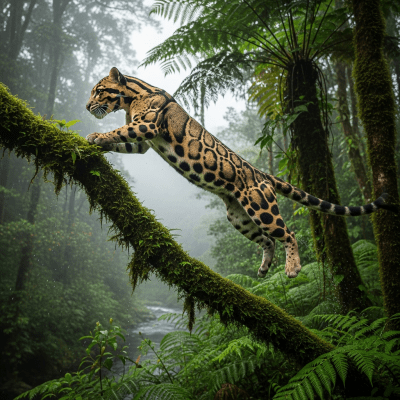

This species thrives in lowland and montane tropical rainforests, peat swamp forests, and occasionally in logged or secondary forests, provided dense canopy cover remains. As an apex predator, the Sunda Clouded Leopard helps regulate populations of arboreal and terrestrial mammals, maintaining ecological balance. Its preference for thick forest environments makes it highly sensitive to habitat disturbance, and its presence is a strong indicator of healthy rainforest ecosystems.
Currently listed as Vulnerable on the IUCN Red List, the Sunda Clouded Leopard faces a high risk of extinction in the wild. This status reflects ongoing threats, declining population trends, and the species' restricted range. Protection measures exist under national laws and international agreements, but continued conservation action is critical for its survival.
The Sunda Clouded Leopard is threatened primarily by habitat loss and fragmentation due to deforestation, illegal logging, and conversion of forests to oil palm and timber plantations. Poaching for the illegal wildlife trade and depletion of prey species further endanger its populations. Its dependence on dense forests makes it especially vulnerable to rapid environmental changes and human encroachment.
Remarkable adaptations enable the Sunda Clouded Leopard to excel in its arboreal habitat. Flexible ankle joints allow for agile climbing and even descending trees headfirst, while its long, bushy tail provides balance among branches. The robust skull and elongated upper canines are specialized for grasping and subduing prey, and its cloud-patterned coat offers effective camouflage in the dappled light of the rainforest.
Reproductive details are still emerging, but gestation lasts around 90 days, with litters of one to three cubs. Cubs are born blind and helpless, requiring extended maternal care. The species' secretive nature means many aspects of its lifecycle remain unknown, but prolonged parental investment is likely key to the survival of young in the challenging rainforest environment.
No formally recognized subspecies or breeds exist for the Sunda Clouded Leopard. While some morphological differences have been observed between Bornean and Sumatran populations, these are not classified taxonomically. The species is considered monotypic, with all individuals belonging to Neofelis diardi.
Genetic research has revealed that the Sunda Clouded Leopard diverged from its mainland relative about 1.4 million years ago, confirming its status as a distinct species. Mitochondrial and nuclear DNA markers have been sequenced, and partial genome data is available in public databases. Phylogenetically, Neofelis diardi is the sister species to Neofelis nebulosa, with both forming a lineage basal to the big cats of the genus Panthera. These insights have deepened understanding of felid evolution and biodiversity in Southeast Asia.