
Leptailurus serval
The serval (Leptailurus serval) is a medium-sized wild cat native to sub-Saharan Africa, instantly recognized by its long legs, large ears, and striking spotted coat.
The serval (Leptailurus serval) is a medium-sized wild cat native to sub-Saharan Africa, instantly recognized by its long legs, large ears, and striking spotted coat.
First described by Johann Christian Daniel von Schreber in 1776, the serval’s scientific journey began with specimens collected across southern and eastern Africa. Originally classified as Felis serval, it now resides in the genus Leptailurus. The serval’s lineage is distinct within Felidae, with no known hybrid ancestry, and its evolutionary roots trace deep into the grasslands and wetlands of Africa.
The serval belongs to the family Felidae, subfamily Felinae, and is classified under the genus Leptailurus. Closely related to the caracal and African golden cat, it is one of the most specialized small wild cats. Historically, up to 18 subspecies have been proposed, though genetic research suggests only a few are valid, with ongoing debate about regional forms.
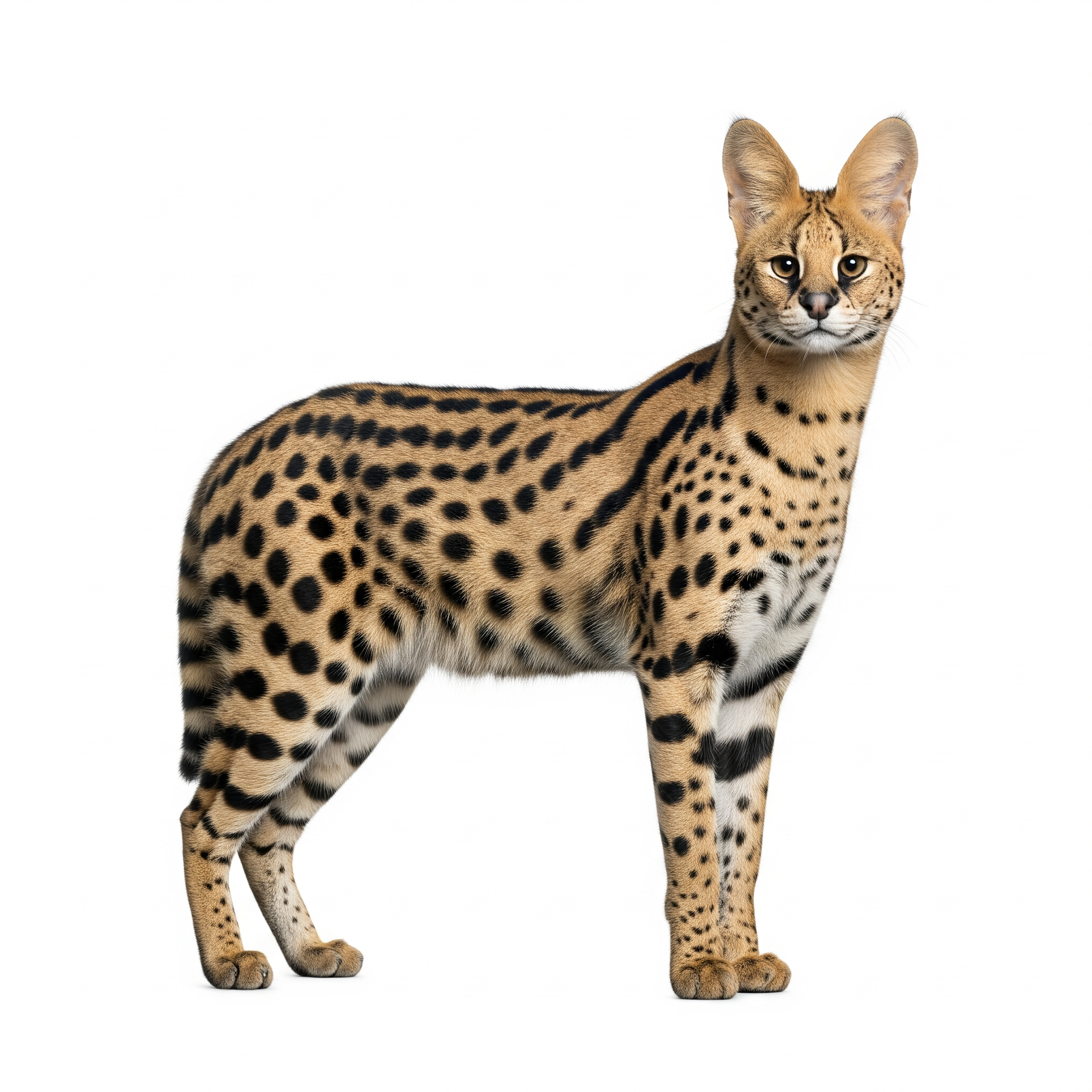
Servals are slender and athletic, boasting the longest legs relative to body size among all felines. Their small heads feature prominent, rounded ears, and their coats shimmer in yellowish to tawny hues adorned with bold black spots and stripes. Adults typically weigh 8–18 kg and measure 59–92 cm in body length, with tails reaching 30–45 cm. The serval’s coat provides excellent camouflage in tall grasses, while its elongated toes and semi-retractable claws are adapted for soft, marshy ground.
Servals are solitary, territorial, and primarily crepuscular or nocturnal hunters. Their home ranges span 10–30 square kilometers, depending on habitat richness. Renowned for their agility, servals can leap up to 3 meters vertically to snatch birds or rodents from the air. Their large ears grant them acute hearing, essential for detecting small prey in dense vegetation. While rarely interacting with humans, servals play a vital ecological role as mesopredators, helping regulate populations of small mammals and birds.
Bring this kind into your world � illustrated posters, mugs, and shirts.
Archival print, museum-grade paper
Buy Poster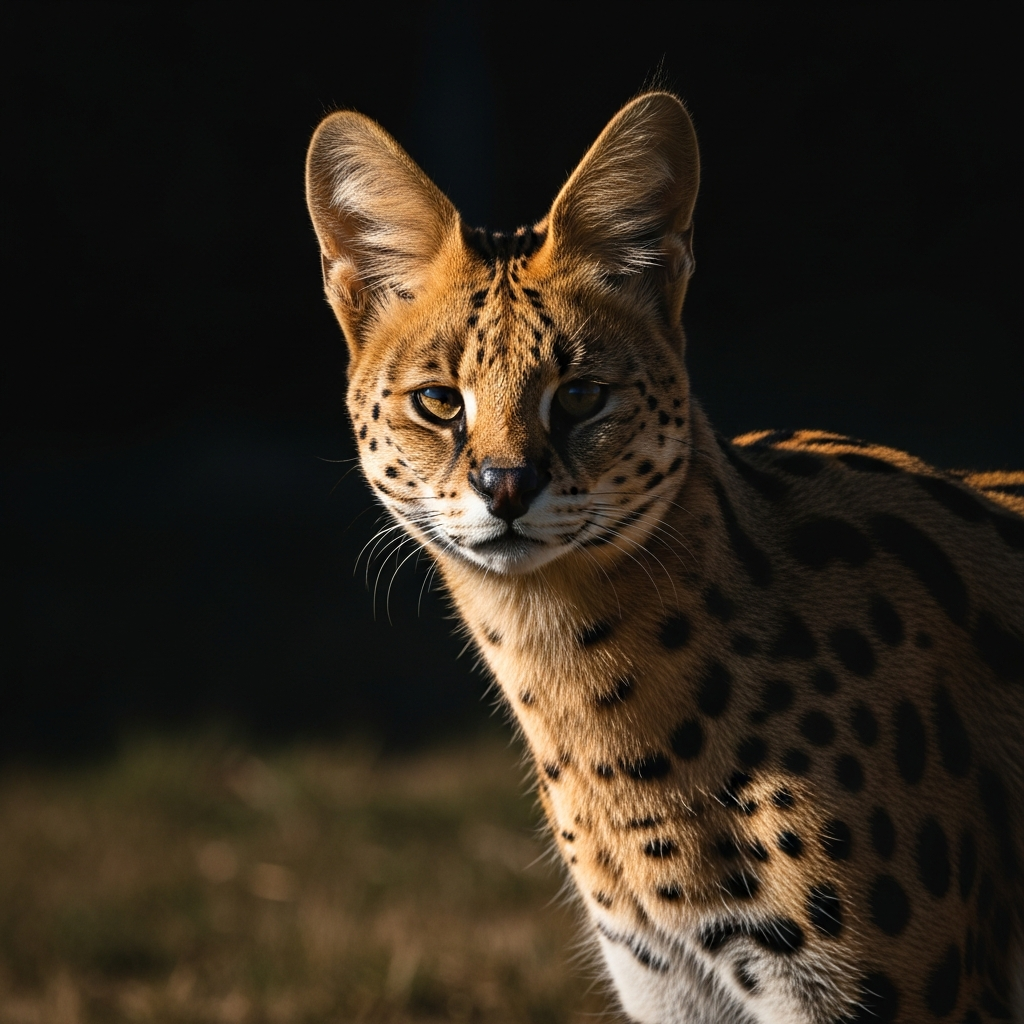
Stoneware mug, dishwasher safe
Buy Mug
Soft cotton tee, unisex sizes
Buy ShirtThough not as prominent in folklore as lions or leopards, servals are occasionally referred to as "tiger cats" in some African regions and feature in local stories highlighting their agility and stealth. In modern times, servals have gained attention through the exotic pet trade and as the wild parent of the "savannah cat" hybrid, sparking debates about conservation and ethical ownership. Their elegant form and striking coat patterns have also inspired artists and designers.
Servals are widely distributed across sub-Saharan Africa, from Senegal and Ethiopia in the north to South Africa in the south. Their historical and current range encompasses most regions with suitable grassland, wetland, or savanna habitats, though they are absent from dense forests and true deserts.
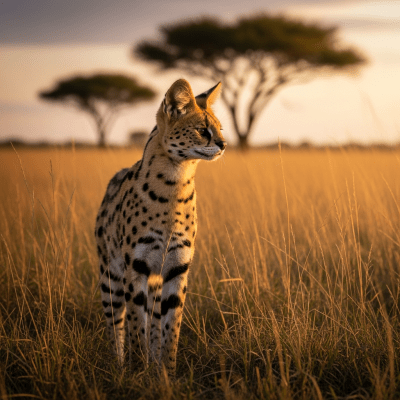
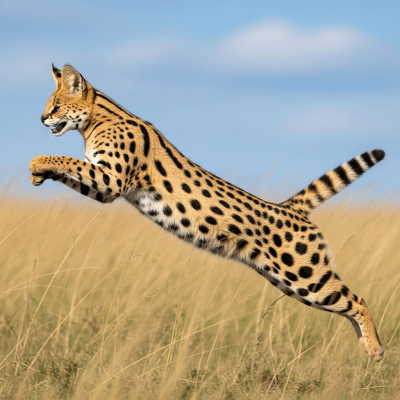

Servals thrive in savannas, wetlands, and grasslands characterized by tall vegetation and abundant water sources. They avoid dense forests and arid deserts, relying on open landscapes for hunting and shelter. As mesopredators, servals play a crucial role in controlling populations of small mammals, birds, and reptiles, contributing to ecosystem balance and biodiversity.
The serval is currently listed as Least Concern by the IUCN Red List, reflecting its broad distribution and stable population trends. However, local declines are noted where habitat loss and fragmentation occur, and ongoing monitoring is essential to ensure long-term stability.
Major threats to servals include habitat destruction due to agriculture and urban expansion, persecution by humans, and illegal capture for the exotic pet trade. In some regions, servals face local declines as wetlands and grasslands are converted or degraded, reducing available habitat and prey.
Servals are equipped with long legs and elongated toes for traversing soft, marshy ground, and semi-retractable claws for agile movement. Their large ears are highly sensitive, enabling them to detect prey even underground. The serval’s spotted coat provides effective camouflage in tall grasses, and their powerful leaping ability allows them to ambush prey with remarkable precision.
Female servals give birth to litters of 1–4 kittens after a gestation period of 66–77 days. Kittens are born in concealed nests within tall grass or dense vegetation and remain hidden for several weeks. Maternal care is intensive, with mothers providing food and protection until the young are old enough to accompany her on hunts. Servals reach maturity at around one to two years of age, after which they establish their own territories.
While up to 18 subspecies have been proposed historically, recent genetic studies suggest only a few are valid, and boundaries remain under scientific review.
Genetic research places the serval firmly within the Felinae subfamily, closely related to the caracal and African golden cat. Mitochondrial DNA and nuclear genome data confirm low genetic divergence among populations, supporting limited subspecies differentiation. Hybridization is rare in the wild but has occurred in captivity, notably resulting in the "savannah cat" hybrid. Ongoing genetic studies continue to refine understanding of serval diversity and evolutionary relationships.