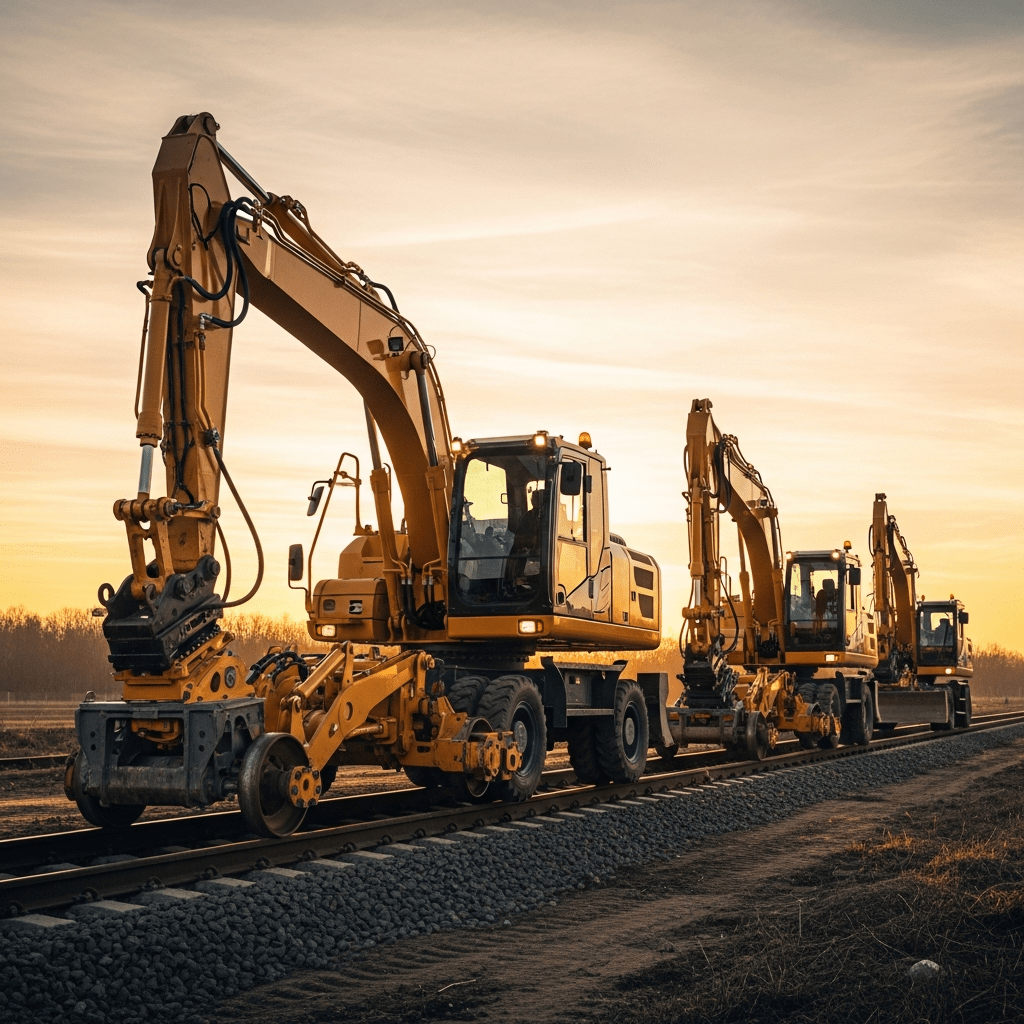
Rail-mounted excavator
A rail-mounted excavator is a specialized hydraulic excavating machine equipped with rail gear that enables it to operate directly on railway tracks for maintenance, construction, and utility tasks.
A rail-mounted excavator is a specialized hydraulic excavating machine equipped with rail gear that enables it to operate directly on railway tracks for maintenance, construction, and utility tasks.
Rail-mounted excavators originated in the late 20th century as adaptations of standard hydraulic excavators to meet the unique demands of railway infrastructure maintenance. Developed primarily in Europe, North America, and Asia, these machines evolved through collaboration between railway authorities and equipment manufacturers such as Liebherr, Komatsu, Caterpillar, and Volvo. Since the 1980s, continuous improvements have enhanced their safety systems, attachment versatility, and dual-mode mobility for both rail and road operation.
Classified within the hydraulic excavator family, rail-mounted excavators fall under the "standard" size band and feature a rail mobility system. They are distinguished by their integration of retractable rail wheels or rail gear, allowing them to travel along tracks while performing excavation tasks. Their primary powertrain is typically a diesel internal combustion engine, and they are predominantly manned, with emerging remote-control capabilities.
Visually, rail-mounted excavators resemble conventional hydraulic excavators but are mounted on chassis fitted with retractable rail wheels or specialized rail gear. They usually weigh between 15 and 30 metric tonnes and feature articulated booms and arms controlled by hydraulic cylinders. Some models offer zero-tail swing designs to navigate confined rail corridors, and their attachments range from digging buckets to specialized rail clamps, giving them a versatile and robust appearance suited for rail environments.
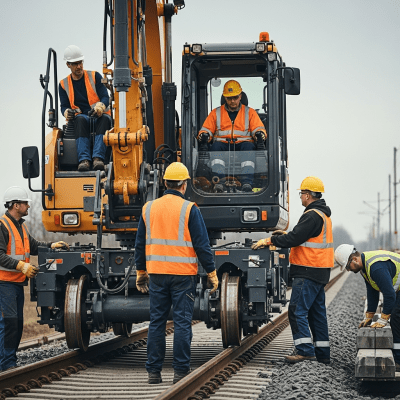
These excavators are primarily used for railway maintenance-of-way operations, including track renewal, ballast handling, sleeper replacement, drainage, vegetation management, and utility installation. Their rail mobility allows them to move efficiently along tracks, positioning themselves precisely for work. Dual-mode variants can also travel on roads, enhancing their flexibility for rapid response and infrastructure upgrades. Operators typically control them from onboard cabs, though remote operation is increasingly adopted in hazardous or confined settings.
Bring this kind into your world � illustrated posters, mugs, and shirts.
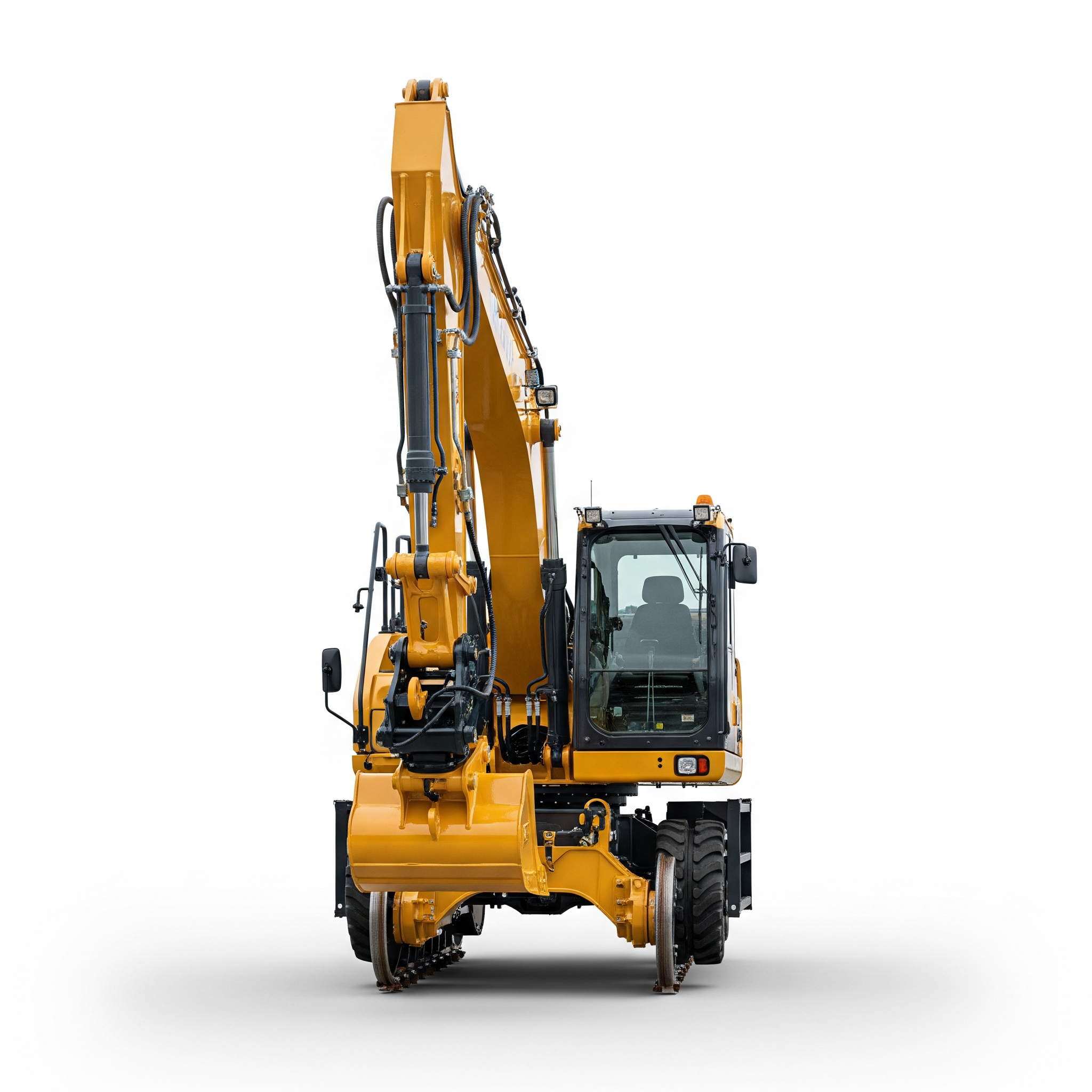
Archival print, museum-grade paper
Buy Poster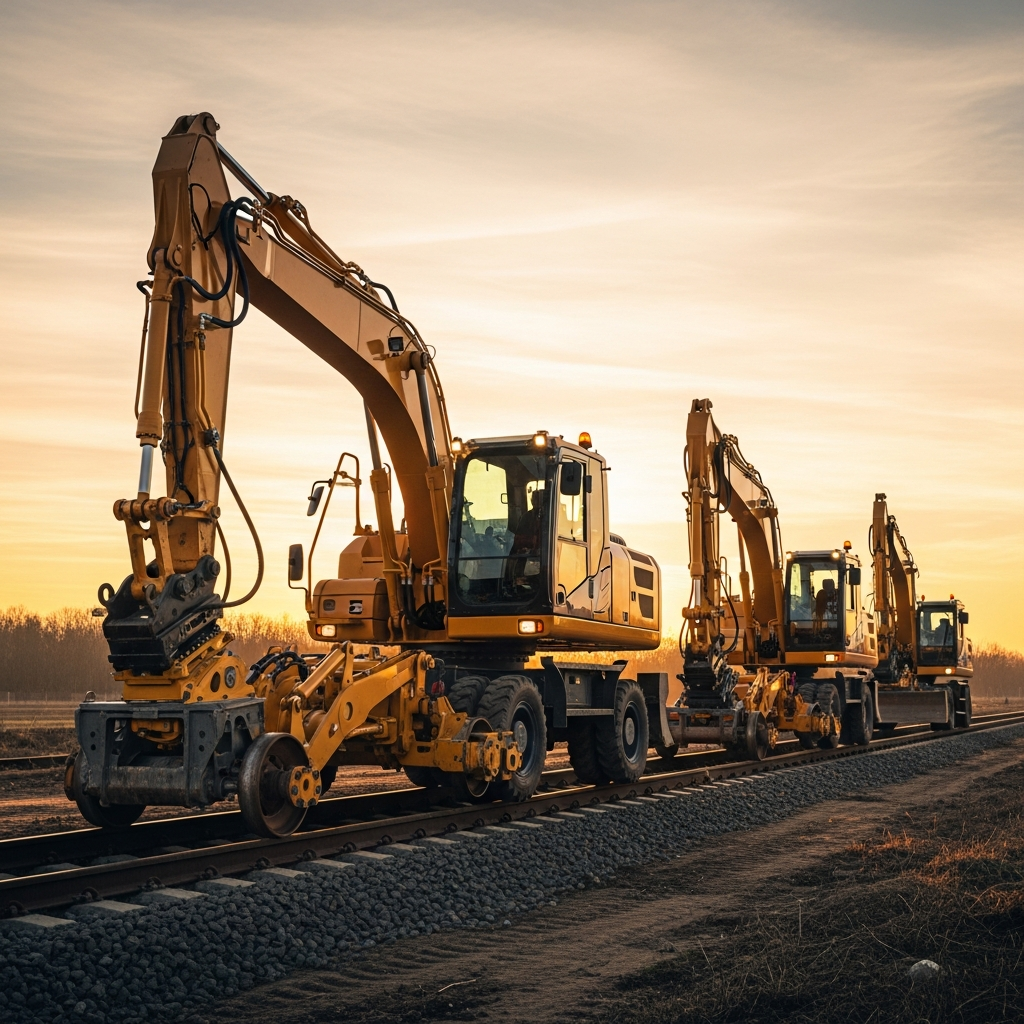
Stoneware mug, dishwasher safe
Buy Mug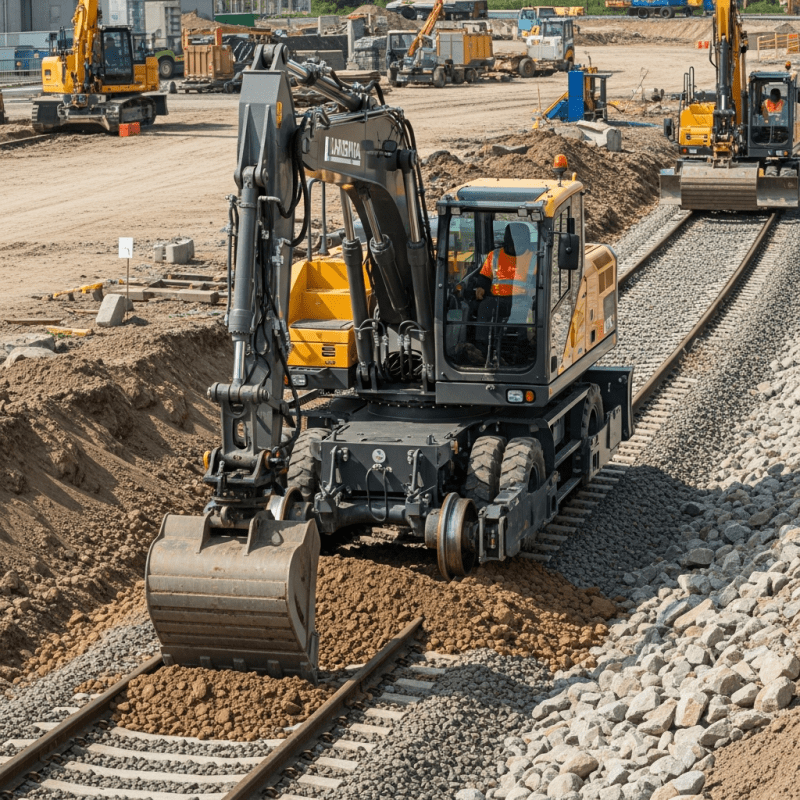
Soft cotton tee, unisex sizes
Buy ShirtWhile rail-mounted excavators are primarily functional machines, they hold significant importance in modern rail infrastructure culture. They symbolize the technological evolution supporting safe and efficient railway operation worldwide. In regions with dense rail networks, these machines are integral to maintaining the lifelines of commerce and travel, and their specialized design reflects the intersection of heavy machinery engineering and railway heritage.
Rail-mounted excavators use hydraulic actuation through an articulated boom and arm powered by hydraulic cylinders. The chassis is specially designed with retractable rail wheels or rail gear that engage with railway tracks, enabling stable movement along rails. The hydraulic system provides precise control for excavation, lifting, and positioning tasks essential for railway maintenance. The integration of rail-specific braking and interlock systems ensures safe operation on live tracks, while the hydraulic powertrain delivers the necessary force to handle ballast, sleepers, and other track components.
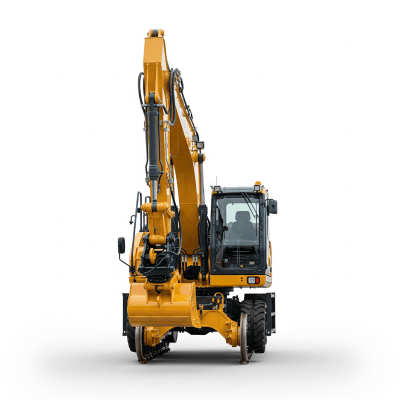
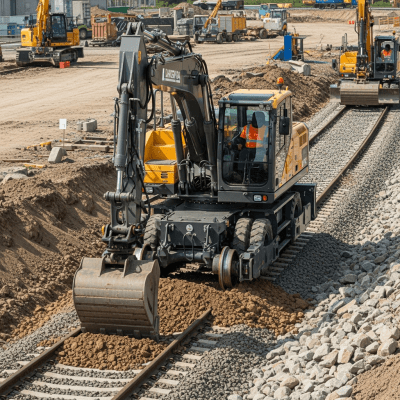
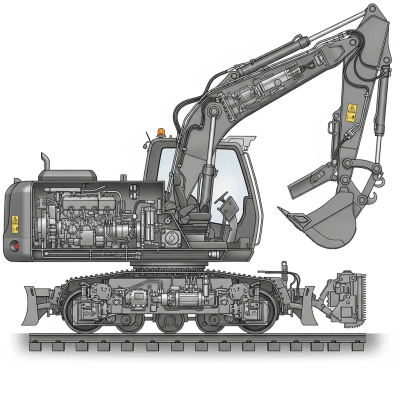
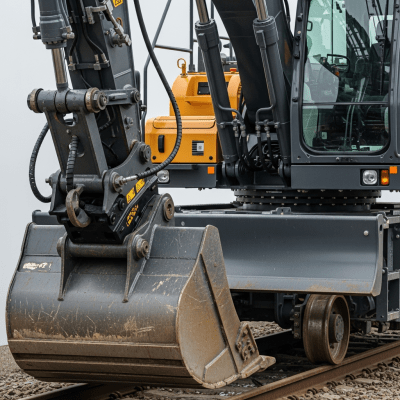
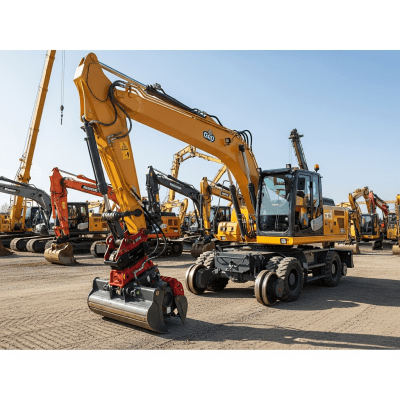
Mobility for rail-mounted excavators centers on rail chassis equipped with retractable rail wheels, allowing seamless transition between rail and road modes. This dual-mode mobility offers operational flexibility, enabling machines to travel on public roads to reach job sites and then switch to rail mode for track work. Compared to crawler or wheeled excavators, rail-mounted variants are uniquely adapted for linear travel along rails, with specialized braking and safety systems to comply with railway standards.
Rail-mounted excavators generally fall within the standard size class, with operating weights between 15,000 and 30,000 kilograms. Their rated engine power typically ranges from 90 to 150 kilowatts, providing sufficient power for demanding rail maintenance tasks. Bucket capacities vary from 0.5 to 1.2 cubic meters, balancing the need for precision and efficiency. Maximum reach spans approximately 8 to 10 meters, enabling access to trackside components and ballast beds without repositioning the machine frequently.
Safety features on rail-mounted excavators include rail-specific interlocks, fail-safe braking systems, track circuit isolation, and high-visibility warning systems to ensure safe operation near live tracks. They comply with international and regional standards such as EN 15746, OSHA regulations, and HSE UK requirements. Emissions standards typically meet Tier 4 diesel engine classifications, reflecting efforts to reduce environmental impact while maintaining performance in rail environments.
Common attachments for rail-mounted excavators enhance their versatility in railway maintenance. These include standard digging buckets for earthmoving, ballast tampers for track stabilization, sleeper handlers for replacing ties, vegetation mowers for clearing trackside growth, hydraulic breakers for breaking hard surfaces, grapples for material handling, and specialized rail clamps to secure components during work. These accessories enable the machine to perform a wide range of tasks essential to rail infrastructure upkeep.
Rail-mounted excavators require rigorous maintenance due to the stresses of rail operation and regulatory inspections. Regular servicing focuses on hydraulic systems, rail gear mechanisms, engine performance, and safety features to ensure reliability and compliance. Their typical service life spans 10 to 20 years, influenced by usage intensity and adherence to maintenance schedules. Operators must also monitor wear on rail wheels and braking systems to maintain safe and efficient operation on tracks.